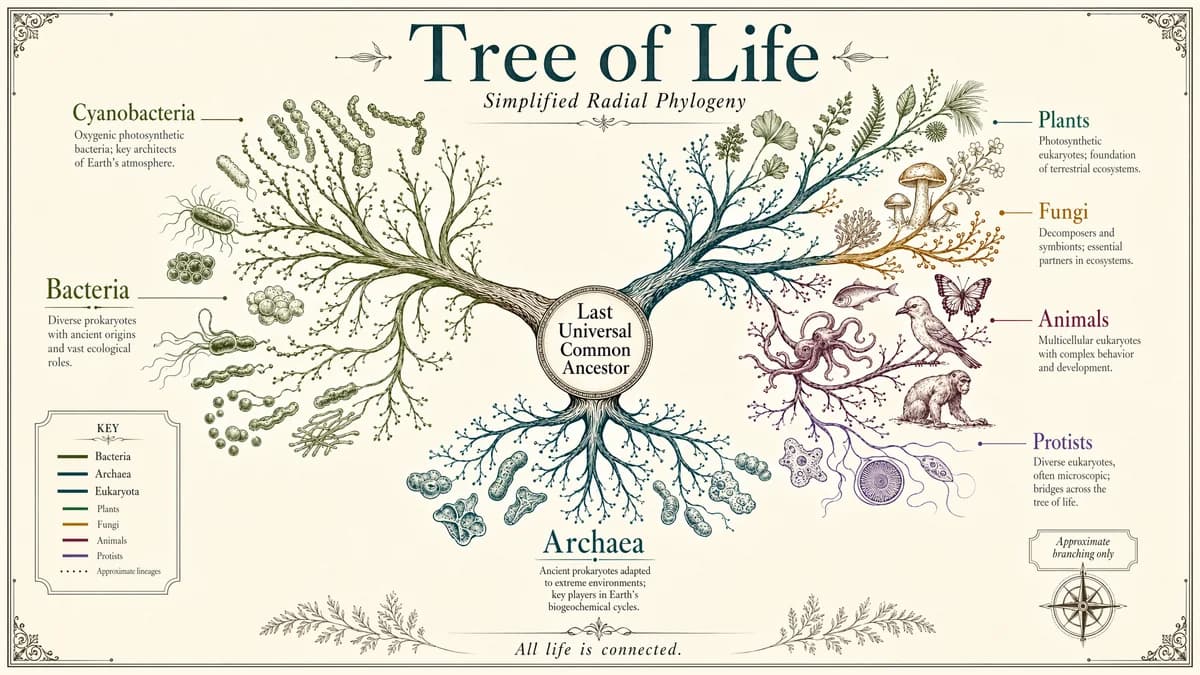
Lebensbaum-Plakat
Mehr Infografiken
Methodenabbildung im ICLR-Stil
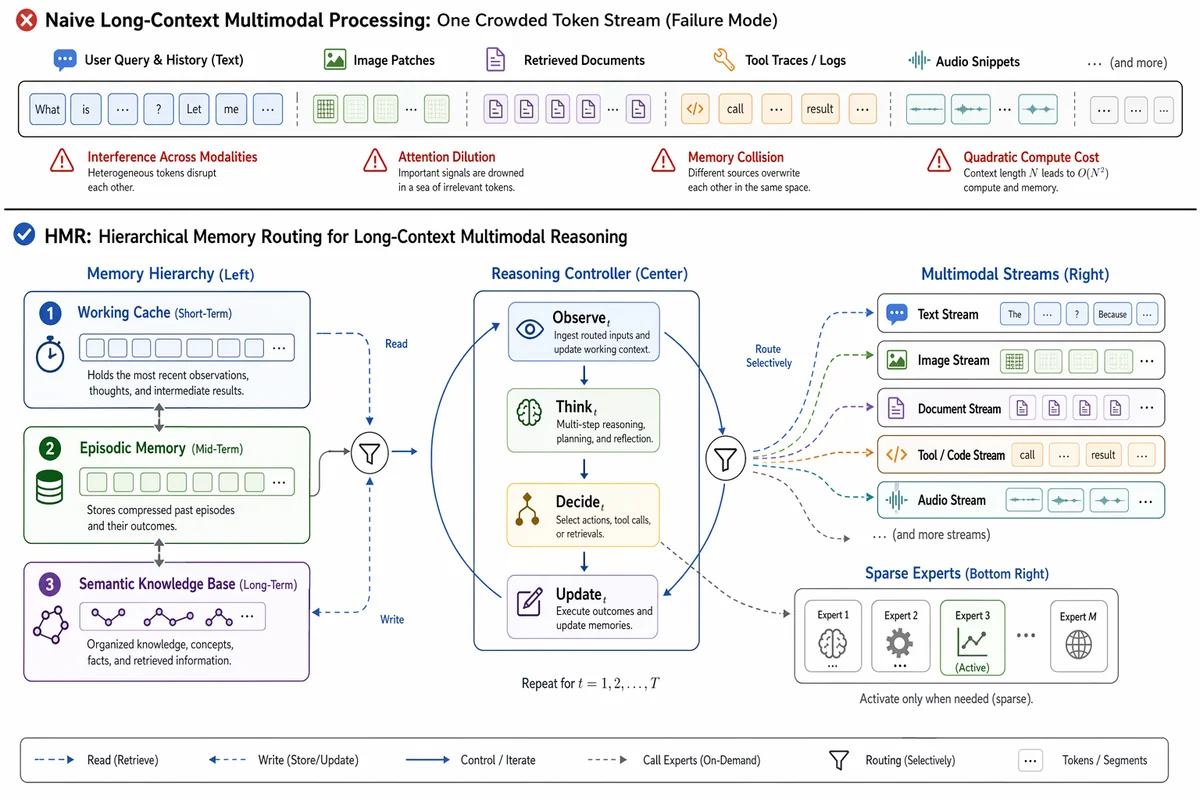
Create a polished ICLR-style Figure 1 for an imaginary method called "Hierarchical Memory Routing for Long-Context Multimodal Reasoning (HMR)". The top band shows the failure mode of naive long-context multimodal processing: one overcrowded horizontal token stream mixing text, image patches, retrieved documents, tool traces, and audio snippets, with red-orange warning accents for interference, attention dilution, memory collision, and quadratic compute cost. A clean horizontal divider separates the main lower panel, which presents the HMR framework as a spacious modular loop. Center: a Reasoning Controller with stages Observe_t to Update_t. Left: a three-level Memory Hierarchy with working cache, episodic memory, and semantic knowledge base. Right: Multimodal Streams entering selectively through routing paths. Bottom right: sparse experts activated only when needed. White background, vector-clean styling, neutral gray plus cool accents, minimal but legible labels, conference-paper clarity, no poster aesthetics.
Frontier-Safety-Evaluationsschleife
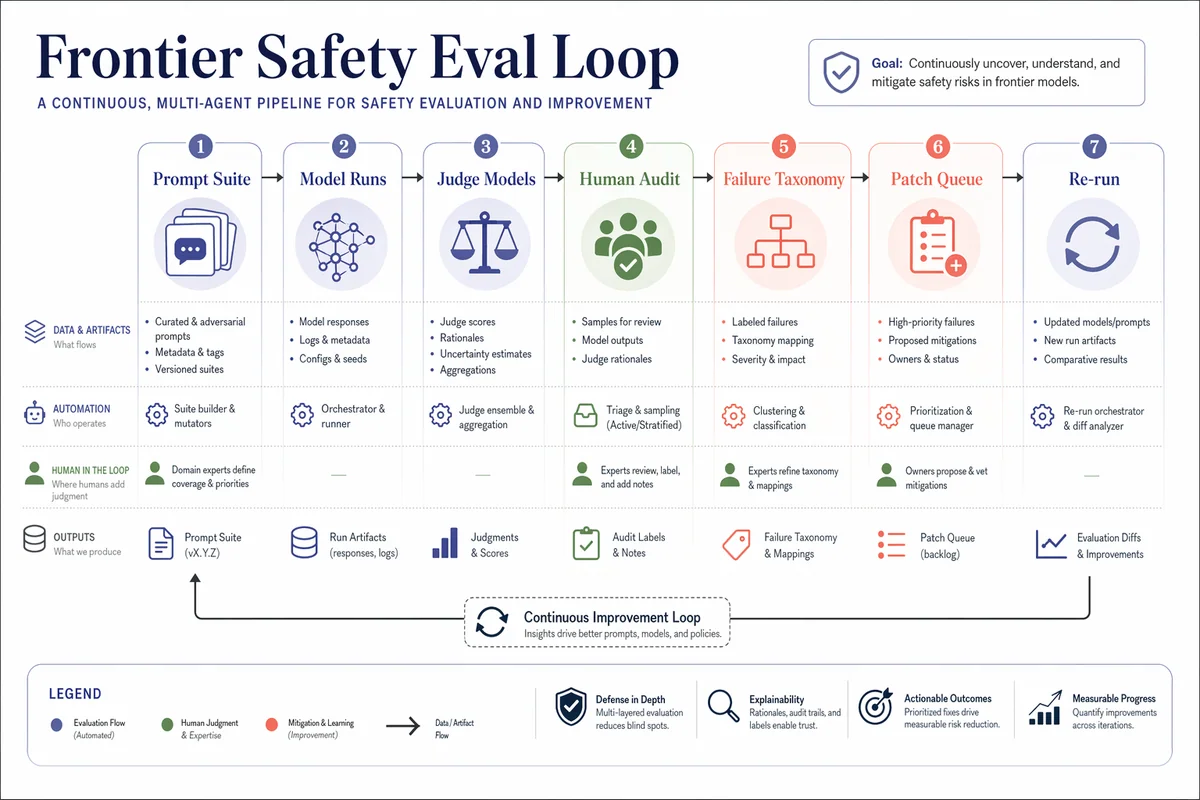
Create a beautiful research flowchart for an AI safety benchmark pipeline called Frontier Safety Eval Loop. Landscape figure, white background, large typography, vector-like shapes, soft indigo, coral, sage, and graphite palette. Show stages Prompt Suite, Model Runs, Judge Models, Human Audit, Failure Taxonomy, Patch Queue, and Re-run. Use clean swimlanes, numbered callouts, compact legends, and premium paper-ready styling. High detail, excellent color harmony, generous whitespace, no clutter, conference-quality diagram.
Memory-Router für multimodale Agenten
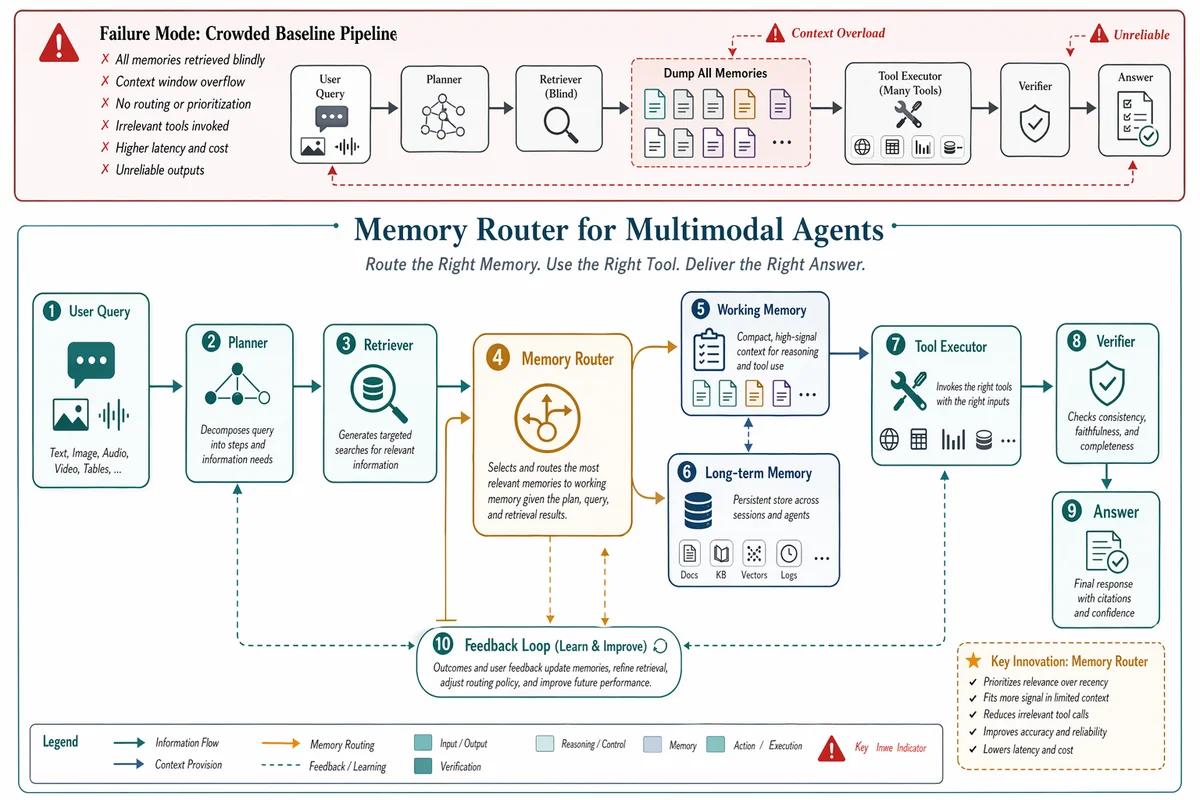
Design a premium conference-paper figure for an imaginary method called Memory Router for Multimodal Agents. Landscape layout, pure white background, large readable labels, elegant vector-clean boxes and curved arrows, tasteful teal slate and amber palette. Top strip shows the failure mode of a crowded baseline pipeline with red warning accents. Main panel shows User Query, Planner, Retriever, Tool Executor, Memory Router, Working Memory, Long-term Memory, Verifier, and a feedback loop. Beautiful spacing, crisp legend, subtle depth, polished academic styling, highly detailed but uncluttered.
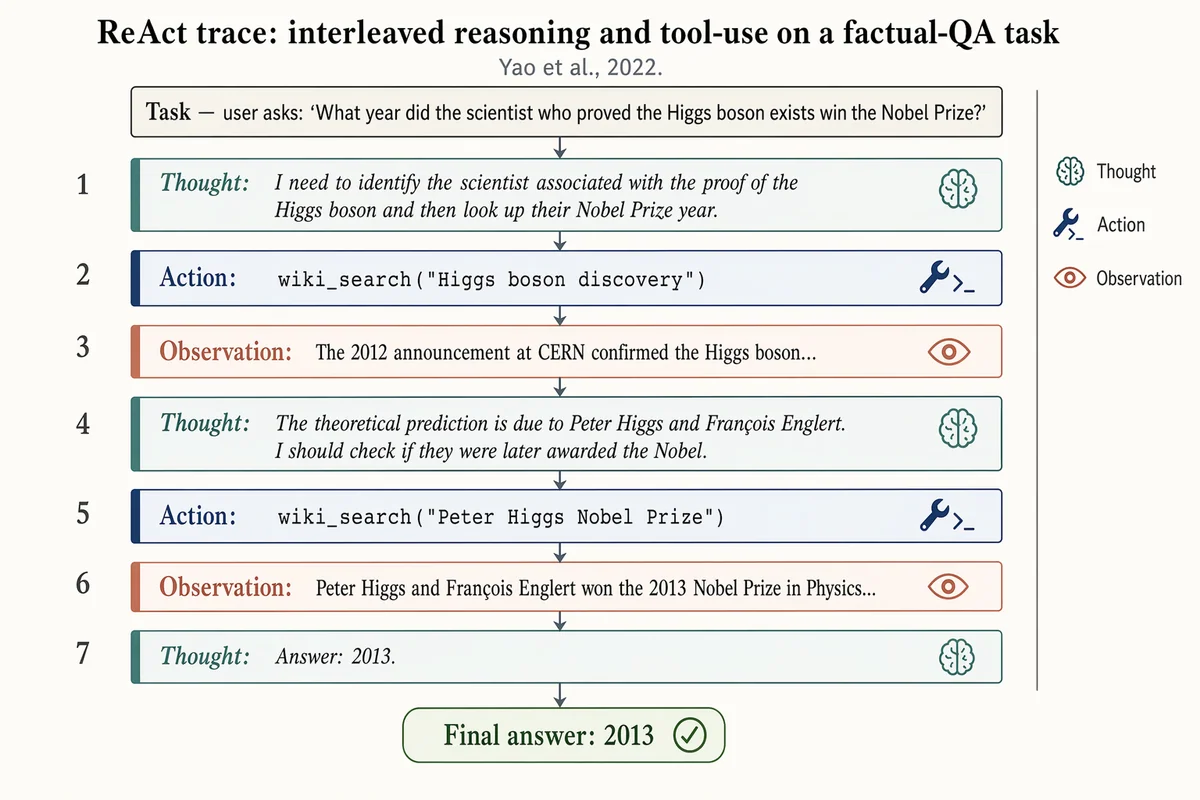
ReAct-Reasoning-Trace
Landscape 16:9 figure of a ReAct trace on a factual-QA task, vertical sequence of 7 alternating blocks. Top header: "Task — user asks: 'What year did the scientist who proved the Higgs boson exists win the Nobel Prize?'" Seven blocks, top-to-bottom, each numbered 1–7 on the left: 1. Thought: "I need to identify the scientist associated with the proof of the Higgs boson and then look up their Nobel Prize year." 2. Action: wiki_search("Higgs boson discovery") 3. Observation: "The 2012 announcement at CERN confirmed the Higgs boson..." 4. Thought: "The theoretical prediction is due to Peter Higgs and François Englert. I should check if they were later awarded the Nobel." 5. Action: wiki_search("Peter Higgs Nobel Prize") 6. Observation: "Peter Higgs and François Englert won the 2013 Nobel Prize in Physics..." 7. Thought: "Answer: 2013." Thought blocks: dusty-teal left border, italic, brain glyph. Action blocks: muted-navy left border, monospace, wrench glyph. Observation blocks: soft-terracotta left border, lighter fill, eye glyph. Thin slate-gray arrows between blocks. Bottom: pill-shaped "Final answer: 2013" with a check glyph. Title: "ReAct trace: interleaved reasoning and tool-use on a factual-QA task". Subtitle: "Yao et al., 2022."
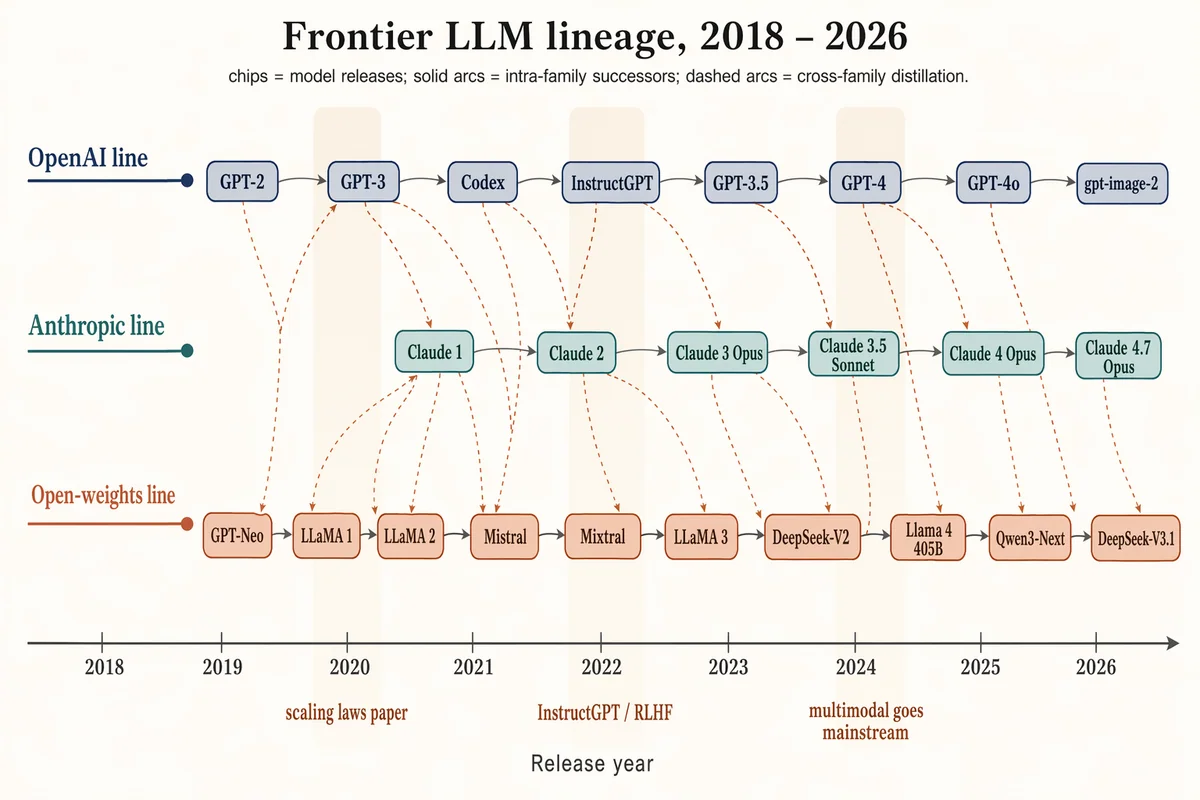
Frontier-LLM-Stammbaum (2018–2026)
Landscape 16:9 timeline / family tree of frontier LLMs 2018–2026, three vertically stacked lanes over a horizontal time axis. Time axis ticks: "2018", "2019", "2020", "2021", "2022", "2023", "2024", "2025", "2026". LANE 1 (top, muted navy) "OpenAI line": chips "GPT-2", "GPT-3", "Codex", "InstructGPT", "GPT-3.5", "GPT-4", "GPT-4o", "gpt-image-2". LANE 2 (middle, dusty teal) "Anthropic line": chips "Claude 1", "Claude 2", "Claude 3 Opus", "Claude 3.5 Sonnet", "Claude 4 Opus", "Claude 4.7 Opus". LANE 3 (bottom, soft terracotta) "Open-weights line": chips "GPT-Neo", "LLaMA 1", "LLaMA 2", "Mistral", "Mixtral", "LLaMA 3", "DeepSeek-V2", "Llama 4 405B", "Qwen3-Next", "DeepSeek-V3.1". Solid slate-gray arcs = intra-family successors; warm-copper dashed arcs = cross-family distillation. Soft vertical highlight bands at 2020 ("scaling laws paper"), 2022 ("InstructGPT / RLHF"), 2024 ("multimodal goes mainstream"). Title: "Frontier LLM lineage, 2018 – 2026". Subtitle: "chips = model releases; solid arcs = intra-family successors; dashed arcs = cross-family distillation."
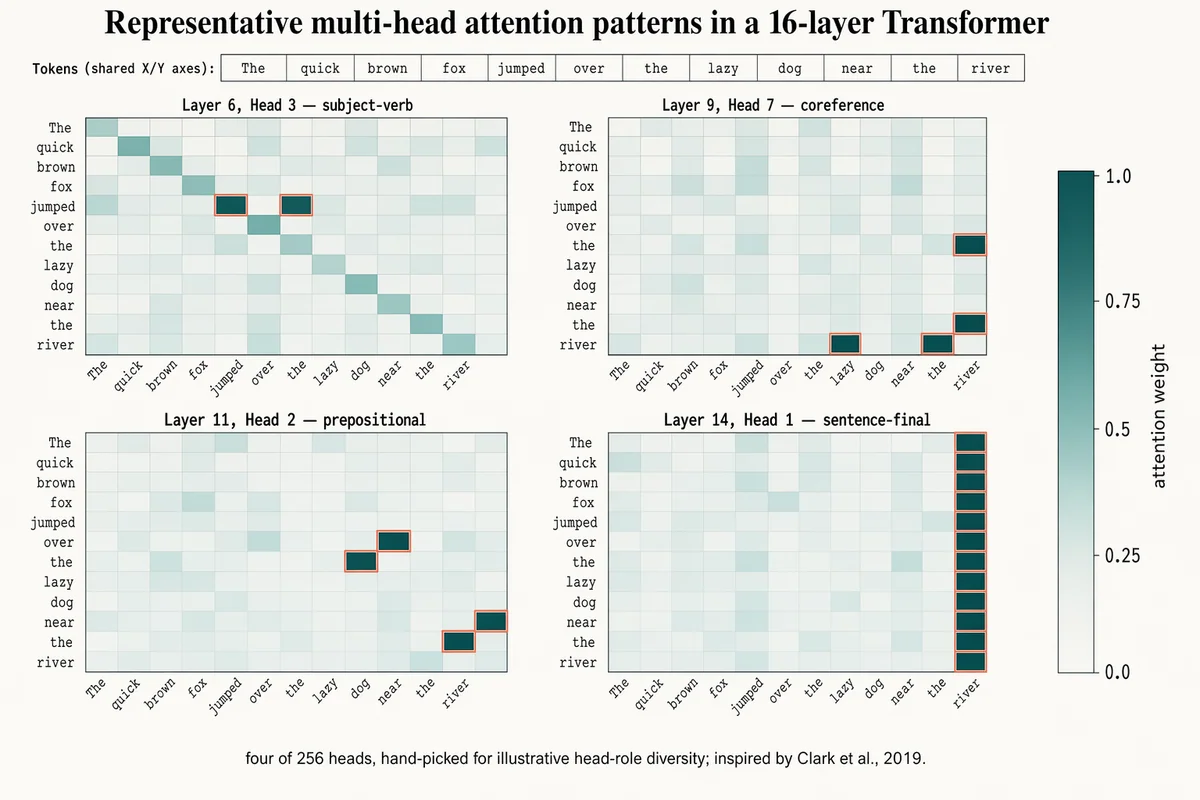
Multi-Head-Attention-Heatmaps
Landscape 16:9 figure of 4 attention heatmaps (2×2 grid), shared 12-token input. Token labels across X and Y (rotated 45° on X): "The", "quick", "brown", "fox", "jumped", "over", "the", "lazy", "dog", "near", "the", "river". Four 12×12 cell panels with individual titles: "Layer 6, Head 3 — subject-verb" (highlighted cells between "fox"/"jumped") "Layer 9, Head 7 — coreference" (highlighted cells between "the"(×2)/"river") "Layer 11, Head 2 — prepositional" (highlighted cells between "over"/"dog", "near"/"river") "Layer 14, Head 1 — sentence-final" (activity concentrated in rightmost column) Cells: dusty-teal gradient, darker = higher weight. Peak cells outlined in 1px soft-terracotta. Shared vertical color bar on far right with ticks "0.0", "0.25", "0.5", "0.75", "1.0" and label "attention weight". Title: "Representative multi-head attention patterns in a 16-layer Transformer". Subtitle: "four of 256 heads, hand-picked for illustrative head-role diversity; inspired by Clark et al., 2019."